

When procurement teams evaluate life safety systems, conversations tend to settle quickly on certifications, technical specifications, and price comparisons. All legitimate things to consider. But none of them is the most important question. The question that matters most, and that gets asked explicitly far less often than it should, is this: when the atmosphere in this facility becomes hazardous in the next sixty seconds, will the people here actually be able to use what’s mounted on that wall?
Choosing the right life protection system for a hazardous environment isn’t a product comparison exercise. It’s a system design exercise. The device, its placement, the training that supports it, and the procedural context it operates within all interact. The highest-specification EEBD fitted to an inaccessible mounting, in a facility where no meaningful training has happened, produces a worse outcome than a simpler, well-positioned device that workers have used regularly.
What ‘Life Safety System’ Actually Means
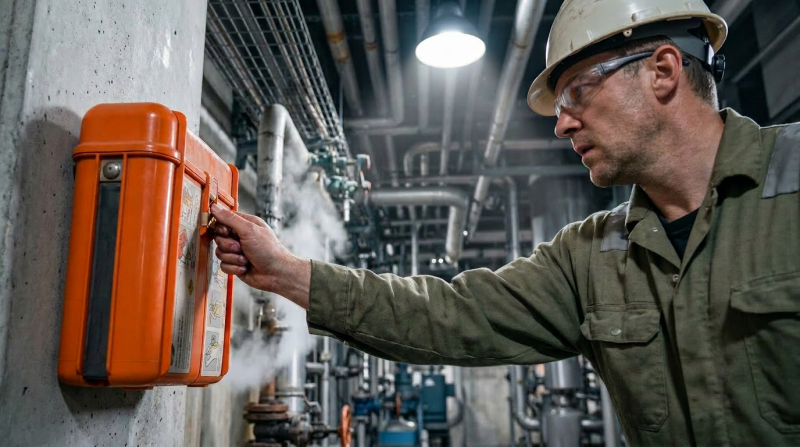
In high-risk industrial and maritime environments, life safety systems are the integrated set of equipment, procedures, and training provisions that let people escape or survive a hazardous atmosphere. At the core of life safety sits: emergency escape breathing devices, their storage infrastructure, and the maintenance and training programmes that keep them functional. These must be easily deployable in complex environments such as offshore platforms, rail tunnels and chemical processing plants. Life safety also extends to evacuation signage, communication provision, rescue apparatus, and confined space rescue capabilities.
‘Life safety’ isn’t marketing language. In environments where atmospheric conditions can shift from safe to unsafe within seconds of a gas release or fire, these systems are what the margin between a near-miss and a fatality rests on. That should inform every decision in the selection process, including those that feel administrative.
The Right System Is Rarely the Most Capable One
The instinct to select the most capable device available is understandable. More features, longer duration, higher spec – these seem like unambiguous improvements when lives are at stake. In practice, the relationship between capability and operational effectiveness is more complicated.
A sophisticated EEBD with multiple activation steps, adjustable hood components, and a range of configurations may perform exceptionally well in a test. In a chemical plant during a gas release, with workers approaching an EEBD locker from different directions under acute stress, that complexity becomes a liability. Activation steps that require deliberate cognitive processing take longer when someone is panicking. Hood adjustment that requires fine motor precision is significantly harder when the stress response is doing its thing. A device that looks superior on a specification sheet can produce worse outcomes than a simpler alternative when the people who need to use it aren’t at their cognitive or physical best.
The right escape set is the one that the specific people in the specific environment can deploy and use correctly under the worst conditions they’re realistically likely to face. That definition favours simplicity and reliability over raw capability. A device everyone can correctly don in thirty seconds is more operationally valuable than one with impressive specifications that routinely takes forty-five seconds under stress.
How Environment Should Shape the Selection Decision
Marine Vessels and Offshore Platforms
SOLAS provides a regulatory baseline for fire and life safety systems on vessels covering device counts, required locations, and minimum durations. It’s a minimum, not an operational optimum. On large commercial vessels, SOLAS-compliant placement may still leave some crew members in positions where reaching a device in an emergency isn’t practically achievable. A placement review that maps actual egress paths, not just regulatory position requirements, frequently reveals gaps that the documentation doesn’t.
Offshore platforms often face a broader atmospheric hazard profile with hydrogen sulphide, hydrocarbon vapour and fire products potentially presenting simultaneously. Device selection must confirm compatibility with all credible hazards at the specific installation. A device rated for fire-smoke evacuation may not provide adequate protection in a sour gas release scenario. These are different problems that need different answers.
Rail and Tunnel Infrastructure
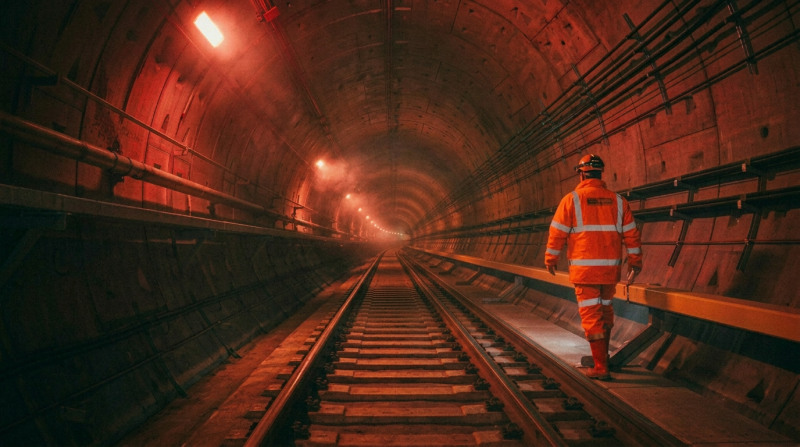
Rail environments, particularly tunnels, introduce constraints that don’t exist elsewhere. Escape routes are often unidirectional or severely limited; distances can be long and conditions from a trackside fire can deteriorate rapidly in an enclosed space. The escape set for rail tunnel workers should be validated against the actual evacuation time data for the relevant tunnel geometry, with the realistic assumption that an actual evacuation will take longer than any timed exercise under controlled conditions.
Chemical and Pharmaceutical Processing
Chemical processing requires device selection grounded in the specific chemical hazard of the process. Ammonia handling, chlorine systems, and hydrogen sulphide-bearing processes each have distinct concentration-time profiles that determine the minimum protection level required. The EEBD must provide adequate protection at the maximum credible atmospheric concentration during the credible escape window, not at average expected exposure levels.
Pharmaceutical and cleanroom environments add a different dimension: the device must be compatible with contamination control requirements. Devices that introduce particulates or incompatible materials during donning may not be appropriate regardless of their respiratory performance. Where life safety requirements and process integrity requirements intersect, specialist assessment is warranted.
Where Selection Decisions Typically Go Wrong
Failure most commonly occurs when treating procurement as a product decision rather than a system design decision. Device selection that happens independently of escape route analysis, training programme design and hazard profile review frequently produces a well-specified device that can’t deliver its potential benefit in practice.
Specific patterns that show up in post-incident and audit findings include: devices positioned for regulatory compliance rather than worker locations; duration selected by default rather than validated against timed data; device complexity not assessed against stressed user performance; training programmes that don’t reflect the conditions in which the device will be used. Any one of these can meaningfully affect outcomes. Together, they can convert a technically compliant installation into a system that doesn’t work when it matters.
A Better Approach to Selection
Start with the hazard profile, not the catalogue. What are the credible atmosphere failure scenarios at this installation? What’s the maximum concentration reachable within the device access and donning window? What are the physical constraints of the evacuation routes? Only once those questions have answers does product selection become a useful exercise.
Where possible, shortlist devices and run timed donning trials with representative users under approximated conditions. It’s a modest investment of time. It’s also the most direct way to find out whether a device’s theoretical performance translates to real user performance and it frequently changes the outcome of the selection.
View Semmco LPS EEBD and life safety equipment
Conclusion
The most important variable in an atmospheric emergency is the total time between hazard onset and completed evacuation. Life safety systems reduce that time through device accessibility, donning simplicity, adequate duration, and a workforce that can use them correctly under pressure. But they only deliver that reduction when selection is grounded in operational reality, not specification comparison.
A life protection system selected for compliance, deployed for administrative convenience, and maintained to the regulatory minimum isn’t a safety system. The organisations that most effectively protect their people are those that treat device selection, placement, training, and maintenance as one problem, because in an emergency, that’s exactly what they are.
