

Emergency Escape Breathing Devices (EEBDs), despite their life-saving potential, are often perceived as simple, static pieces of safety equipment. Yet for the shipping and marine sector, their positioning has profound operational consequences. EEBDs determine whether a crew member can maintain situational awareness, negotiate reduced visibility, and reach safety before smoke, heat or toxic gases overwhelm escape routes. On modern vessels—where machinery spaces, accommodation decks and technical rooms are interconnected and increasingly complex—the decision about where to place an EEBD is as critical as the device itself.
This guide examines EEBD placement through a technical, performance-based safety lens, combining regulatory requirements with practical risk assessment and real-world evacuation behaviour. It is designed for marine safety leaders who want to transform EEBD placement from just a compliance exercise into a measurable improvement in Time-To-Escape (TTE).
Understanding the Regulatory Baseline
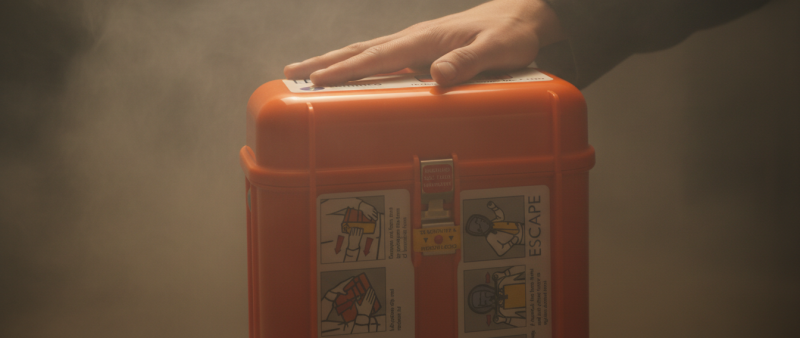
The starting point for EEBD placement is the Safety Of Life At Sea convention, (SOLAS) Chapter II-2 and the Fire Safety Systems (FSS) Code. These standards define minimum quantities and general placement rules. For example, all cargo ships must maintain EEBDs within accommodation spaces, with at least two units immediately accessible plus one spare. Passenger ships require multiple EEBDs per vertical zone, depending on capacity. Passenger Ships need two per main vertical zone (for <36 passengers) or four per zone (for >36 passengers), plus spares. Machinery spaces and confined spaces must contain EEBDs that are highly visible, ready for immediate use and easily accessible from normal working areas. The number is determined by a risk assessment by the ship owner/operator, as layouts vary, but usually requires two EEBDs for personnel entry, or more if high risk.
SOLAS also requires that all EEBD locations be clearly indicated on the fire control plan and that devices meet strict performance criteria, including a minimum operating duration of ten minutes. This ten-minute window forms the foundation of any escape strategy and informs the placement decisions discussed later in this guide.
While these rules provide a critical operational floor, they do not ensure an effective time-to-escape. Compliance ensures the presence of equipment, but optimisation ensures survivability.
Why EEBD Placement Directly Affects Required Safe Egress Time (RSET)
Marine fire safety engineering typically considers the relationship between Available Safe Egress Time (ASET) and Required Safe Egress Time (RSET). ASET defines how long conditions remain tenable; RSET defines how long people need to evacuate. EEBDs do not increase ASET, but they significantly influence RSET, particularly during the recognition, response, and travel phases.
In real incidents, smoke spread, reduced visibility and toxic gas accumulation can reduce escape margins sharply. The time a crew member spends searching for an EEBD or retracing steps to acquire one is time during which tenability conditions may be deteriorating. Research shows that escape delays of even 30–60 seconds can alter survivability thresholds in high-risk environments such as machinery spaces.
For this reason, EEBD placement must be considered part of a performance-based evacuation strategy, not a fixed equipment installation.
Technical Characteristics That Govern EEBD Placement
Understanding the device’s limitations helps shape the placement strategy. EEBDs typically offer:
- A limited air supply, usually designed for around ten minutes of continuous use.
- Single-activation operation, meaning once the device is started, the air supply cannot be paused or conserved.
- Escape-only performance, not suitable for firefighting, entry into hazardous atmospheres or search operations.
- Packaging designed for rapid access, usually involving sealed wall-mounted containers with high-visibility markings.
These technical facts establish certain non-negotiables:
- If an EEBD is difficult to reach, its effective escape duration may be halved before the user even begins moving toward safety.
- If the device is hidden among equipment or poorly signposted, low visibility will impede identification.
- If positioned in deep machinery pockets or dead-end spaces, it may require movement into a more hazardous area to retrieve it—contrary to safe escape principles.
A Structured Framework for EEBD Placement
A systematic approach ensures optimised EEBD distribution rather than arbitrary placements.
1. Identify Realistic Starting Points
Begin by mapping where crew spend most of their time and where atmospheric hazards may arise. These include:
- Engine platforms and the engine control room
- Workshops, purifier rooms and technical spaces
- Galleys, laundries and pantries
- Accommodation corridors, mess rooms and crew day areas
- Control stations such as the bridge, ECR (Engine Control Room) and cargo control room
- Ro-ro (Roll-on-Roll-off) decks, enclosed car decks and cargo holds
Understanding manning patterns, heat sources, ventilation characteristics and escape path geometry ensures EEBDs align with real-world risk.
2. Define Time-To-Escape (TTE)Performance Targets
Assign measurable targets such as:
- Maximum time to reach the nearest EEBD from any routine working position (e.g. 30–45 seconds under normal walking pace).
- Maximum time to reach a safe zone after donning, while maintaining a buffer within the EEBD’s duration.
Performance-based assessments—using route-time calculations or evacuation modelling—can validate whether EEBD placement supports realistic escape under smoke or toxic gas conditions.
3. Overlay Regulatory Minimums with Risk-Based Enhancements
SOLAS provides minimum numbers, but high-risk zones may require additional EEBDs. Supplement placements where:
- Travel distances exceed performance targets
- Smoke spread modelling shows early visibility degradation
- Escape routes converge or diverge
- Crew are isolated from primary escape solutions
Optimising EEBD Placement in Machinery Spaces
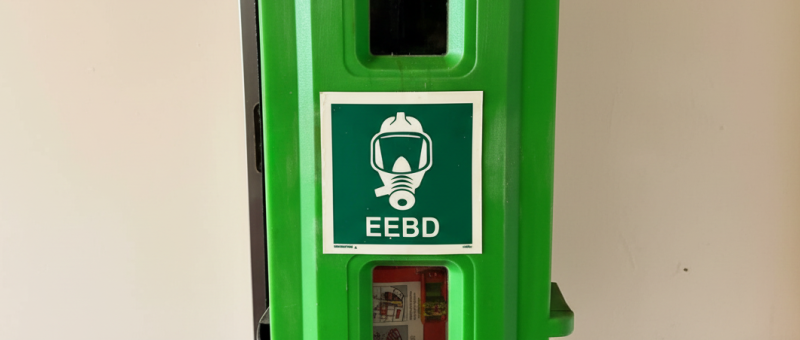
Machinery spaces (the compartment or compartments on a vessel that contain the essential equipment for propulsion, power generation, and the operation of other critical ship systems. Also commonly referred to as the engine room) demand the highest level of scrutiny due to fuel lines, ignition sources and complex layouts. SOLAS requires EEBDs to be “easily visible” and “quickly reachable,” but achieving this in practice can be a challenge.
Key considerations include ensuring devices are installed along natural escape paths, such as outside the engine control room, near escape trunk openings, at ladder entrances and adjacent to frequently used workstations. EEBDs should never be positioned in areas requiring crew to move deeper into the hazard. In multi-level machinery spaces, each tier should have its own accessible EEBDs so that crew are not forced to move up and down between decks under escalating fire conditions.
The visual environment of an engine room is dense, with pipes, cabling and structural components. To reduce search time, EEBDs may require high-contrast mounting boards, backlighting or reinforced signage to maintain visibility even in smoke-darkened atmospheres.
EEBD Placement Within Accommodation Spaces
Accommodation zones may seem lower-risk, but corridor smoke-channelling, fire doors left open and variable occupancy patterns mean visibility can drop rapidly. Placing EEBDs near stairways, lift lobbies and major corridor intersections ensures that crew can access them while moving toward vertical escape routes.
Crew recreation and service areas—mess rooms, lounges, laundries, pantries—can generate smoke due to electrical faults, cooking fires or heat-producing equipment. Positioning EEBDs near these locations provides rapid access for crew who may not be near their cabins when fire breaks out.
For passenger vessels, accessibility takes on added importance. Crew must remain mobile and able to assist passengers, which means EEBDs should be positioned where they can be reached instinctively, without obstructing evacuation paths.
Supporting Escape from Control Stations and Technical Areas
Control stations such as the bridge, engine control room, security control room and cargo control room must continue operations during emergencies for as long as practical. However, atmospheric contamination can develop quickly, especially if ventilation systems fail. Each control room should have:
- One EEBD positioned inside, adjacent to the primary exit.
- One EEBD positioned outside, in the protected lobby or corridor.
This dual arrangement provides redundancy and allows escape even if the control room becomes immediately untenable.
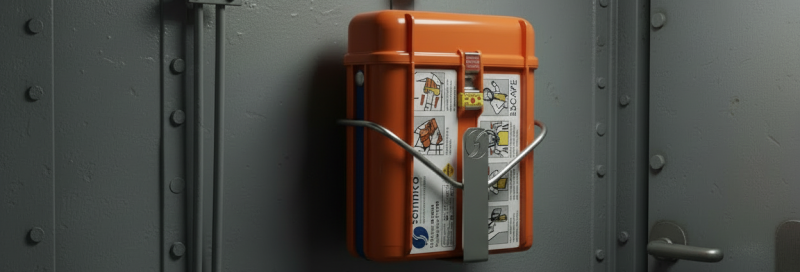
Technical spaces such as switchboard rooms, steering gear compartments and refrigeration plants often have limited entry points. EEBDs must be positioned next to the entrance, ensuring that any crew inside can retrieve one without moving deeper into a hazardous space.
Addressing the Unique Challenges of Ro-Ro and Cargo Spaces
Ro-ro decks have complex airflow patterns and high fire loads. Vehicles, cargo securing equipment and machinery create ignition risks and toxic smoke potential. EEBDs should be positioned at all deck entrances, especially near stair towers, so that crew entering the deck during operations can retreat quickly if conditions deteriorate.
Because mobile equipment can obscure or damage EEBD casings, these placements require additional protection or elevated mounting systems. Cargo spaces where fumigation, chemical transport or refrigeration units operate may require supplementary EEBDs aligned with risk assessments.
Enhancing Human Factors: Visibility, Signage and Accessibility
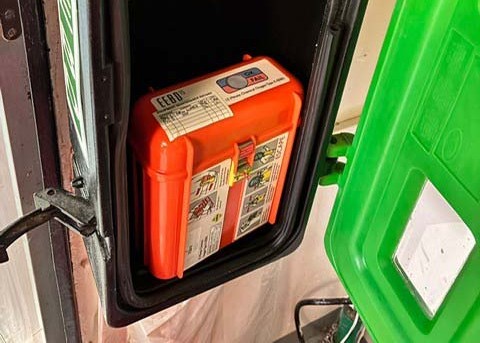
Even perfect placement fails if a crew member cannot locate the EEBD quickly. Signage should be IMO-compliant (International Maritime Organisation), illuminated where possible, and placed at a consistent height. Escape route signage should integrate EEBD locations to reinforce familiarity.
Training is equally essential. Crew members must be able to don an EEBD in low-visibility conditions, under stress and without verbal guidance. Drills should incorporate realistic start points, timed retrieval and full donning procedures. These exercises provide data that can either validate placement or indicate the need for revisions.
Key human factors to consider include:
- Cognitive load during emergency decision-making
- Muscle memory developed through repetition
- Visual search patterns under smoke-filled conditions
- Behavioural delays, such as information-seeking or disbelief
Understanding these behavioural tendencies ensures EEBD placements support intuitive movement rather than requiring conscious searching.
Integrating EEBD Placement into Safety Governance
EEBD distribution should feature prominently in any vessel’s Safety Management System (SMS). Any layout change, equipment installation or operational shift should trigger a review of escape route functionality and EEBD accessibility. The Management of Change (MoC) process should explicitly ask whether the modification alters atmospheric risk profiles or disrupts escape pathways.
Internal audits should confirm not only that EEBDs are present, but that crew can describe and reach the nearest device within the target performance time. Where discrepancies arise, corrective actions may involve repositioning, adding units or enhancing signage.
Common Pitfalls That Increase Time-to-Escape
Several recurring issues compromise EEBD effectiveness:
- Over-reliance on minimum SOLAS placements, leading to insufficient coverage in high-risk zones
- Devices mounted in visually cluttered machinery spaces where they are difficult to identify
- Concentration of EEBDs near primary escape routes while secondary routes remain unsupported
- Lack of alignment between the fire control plan and the vessel’s physical reality
- Drills that do not simulate realistic starting points or timed escape actions
Recognising and correcting these pitfalls can significantly reduce escape times and improve survivability during emergencies.
Conclusion: From Compliance to Performance Optimisation
Effective EEBD placement is not about satisfying regulations, it is about designing a vessel with the understanding that emergencies unfold quickly, unpredictably and often in conditions where visibility and cognition are impaired. By applying a structured, risk-based, technically informed strategy, marine HSE professionals can ensure that EEBDs meaningfully reduce time-to-escape and materially improve crew survival chances.
When EEBDs are placed with clear intention, informed by crew movement patterns, machinery layout, evacuation modelling and human behaviour, they cease being static wall fixtures. They become dynamic tools embedded into the vessel’s safety architecture, ready to be used the moment conditions deteriorate. For safety leaders, this mindset shift transforms emergency preparedness from a checklist into an operational advantage and, most importantly, a life-saving capability.
